Can Foreigners Get Married in France?

Yes — but with real conditions. French law allows two foreigners to marry in France, and it permits same-sex marriage on the same terms as opposite-sex marriage. What stops most visitors is the residency rule: at least one partner must live in the commune for about a month before the banns are published, and the banns must be posted for 10 days before the ceremony. For a couple on a short trip, a legal civil wedding at a Paris town hall is rarely workable. Most international couples handle the legal step at home and come to Paris for a symbolic ceremony.

Key facts at a glance
- A civil marriage in France must be celebrated by a mayor or deputy at a town hall (mairie). No other location is legally valid.
- French law requires at least one month of continuous residence in the commune on the date the banns are published, plus 10 days of banns before the ceremony.
- If both partners are foreigners and do not live in France, a standard mairie wedding is generally not available — the route is the couple’s country-of-origin consulate or an overseas French collectivity.
- A symbolic ceremony has no legal standing in France or abroad. It is a celebration, not a marriage.
- Events in Paris offers symbolic ceremonies only, from €2,500. Couples handle the legal marriage at home.
Do I need to prove residency to elope in Paris?
Legal mairie weddings in Paris require proof of residency — usually about a month of continuous address in the commune. This is handled directly with the town hall and is not part of our packages.
Our symbolic ceremonies require no residency proof. A symbolic ceremony has no legal effect, so French civil-registration rules do not apply. If you are visiting Paris for a few days, you can still hold a full symbolic ceremony with an officiant, flowers, photography, and music.
Legal civil wedding vs symbolic ceremony in France
Who performs the ceremony
Legal civil wedding (mairie): A French civil registrar, mayor, or deputy.
Symbolic ceremony: A professional officiant or celebrant.
Where can it take place
Legal civil wedding (mairie): Town hall, in a room open to the public.
Symbolic ceremony: Anywhere — rooftop, boat, Seine riverbank, Eiffel Tower spot.
Residency requirement
Legal civil wedding (mairie): About one month of continuous residence in the commune before banns are filed.
Symbolic ceremony: None. Visitors can hold a full ceremony.
Banns and waiting period
Legal civil wedding (mairie): 10 days of banns posted at the town hall before the ceremony.
Symbolic ceremony: No banns, no waiting period.
Documents required
Legal civil wedding (mairie): Certified French translations of foreign civil documents.
Symbolic ceremony: No civil documents required.
Legal effect
Legal civil wedding (mairie): Legally changes marital status in France and, via recognition rules, abroad.
Symbolic ceremony: No legal effect. Couples complete the legal marriage at home.
Witnesses
Legal civil wedding (mairie): Two to four witnesses required.
Symbolic ceremony: No witnesses required. Family and friends welcome but optional.
Ceremony language
Legal civil wedding (mairie): French, with an interpreter if needed.
Symbolic ceremony: English, French, or Spanish — additional languages on request.
Cost
Legal civil wedding (mairie): Free at the town hall. Paperwork costs (translations, apostilles) typically €500 to €1,500.
Symbolic ceremony: From €2,500 for symbolic ceremonies with full production.



Is a symbolic wedding legally binding?
No. A symbolic ceremony has no legal effect in France or abroad. It is a celebration, not a marriage.
Because a symbolic ceremony has no legal status, it is not registered anywhere. No marriage certificate is issued. No change to your civil status happens in France, at home, or anywhere else.
That is exactly why international couples choose it. The legal structure of a French civil marriage is designed around residents of that commune, not around visitors. A symbolic ceremony lifts those constraints. You can hold it on a rooftop, on a boat, on the Seine riverbank, or in front of the Eiffel Tower. You can write your own vows. You can exchange rings. You can include readings, unity rituals, and family traditions. None of that requires residency, paperwork, or French civil law.
Most couples complete their legal marriage at home — often at a courthouse or registry office — before or after the Paris ceremony. Whichever order you choose has no bearing on the symbolic ceremony itself.
French law specifically forbids a religious marriage before the civil marriage. That rule applies to religious ceremonies with a religious minister, not to private secular symbolic ceremonies.

Civil marriage in France — what the law says
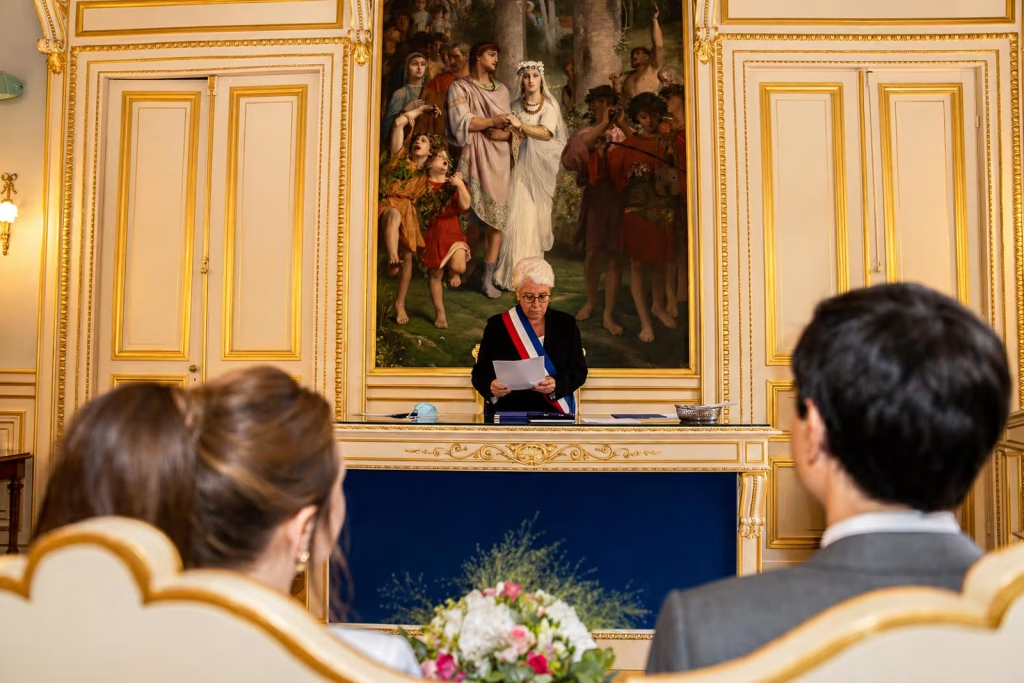
A civil marriage in France is the legal marriage. It is celebrated by the mayor or a deputy at the town hall of a commune where at least one partner has a lasting bond, usually through residence.
French law sets three conditions that most destination couples cannot meet on a short trip:
Lasting bond with the commune. At least one of the two partners must have a sufficient link to the commune where the marriage is celebrated. In practice, that means residence — a real address where the person lives.
One month of continuous residence on the date the banns are published. This is the French legal text. You will sometimes see this described as “40 days” in UK government guidance for British nationals, but the French rule is framed around the banns-filing date, not the ceremony date.
10 days of banns. Once the dossier is accepted, the town hall posts the marriage banns for 10 days. The ceremony can take place from the 10th day after publication, not before.
A short Paris trip — a week, two weeks, even a month of hotel stays — does not satisfy these conditions. The address must be a partner’s actual residence in the commune, supported by documents the town hall accepts as proof: utility bill, rental contract, housing insurance, or tax notice, typically less than three months old.
Can two foreigners who don’t live in France get legally married in France?
Usually no. If both partners are foreign nationals and neither lives in France, a standard town hall marriage is not available. French official guidance points to two alternatives: the consulate of the couple’s country of origin, or a French commune in an overseas collectivity.
In practice, the consulate route depends entirely on which country you come from. Most embassies in Paris do not perform marriages for their own nationals. A few do, and only with their own conditions.
What your country’s consulate in Paris does
Here is the current position for the four nationalities most of our clients come from. If your country is not listed, check with your embassy directly.
| Nationality | Consulate marriage in France | Condition | Source |
|---|---|---|---|
| United States | No | US consular officers cannot perform marriages abroad | travel.state.gov |
| United Kingdom | No | France is not on GOV.UK’s consular-marriage list | gov.uk |
| Germany | No | German missions no longer perform marriages abroad | auswaertiges-amt.de |
| Brazil | Yes — both spouses must be Brazilian | Brazilian-law marriage at the Paris consulate | gov.br |
United States
Verdict: the US Embassy in Paris does not perform marriages in France.
The US Department of State is direct on this: consular officers cannot perform marriages abroad. Americans who want a legal marriage in France must follow French civil law through a mairie — with all the residency conditions above — or marry at home. The embassy in Paris does not offer a ceremony on its premises.
The embassy can issue an “Attestation tenant lieu de certificat de coutume et de célibat”, a sworn statement used in the French dossier when required. That is a document service, not a marriage service.
United Kingdom
Verdict: the British Embassy in Paris does not perform marriages in France.
France is not on GOV.UK’s current list of countries where British embassies perform consular marriages. British couples marrying in France follow French civil law through a mairie. UK government guidance for France uses a “40 days before the ceremony” shorthand for the residency requirement — a practical UK restatement of the French one-month-on-banns rule.
GOV.UK does not issue a UK Certificate of No Impediment for France. A self-declaration form is used in its place.
Germany
Verdict: the German Embassy in Paris does not perform marriages in France.
Under German law, German missions abroad no longer perform marriages. A German couple marrying in France must follow French civil law through a mairie and will usually need an Ehefähigkeitszeugnis — a German certificate of eligibility to marry — for the French dossier.
Brazil
Verdict: the Brazilian Consulate-General in Paris can celebrate marriages under Brazilian law, but only between two Brazilian nationals. Mixed-nationality couples cannot use this route.
A consular marriage under Brazilian law is registered at the consulate and must be transcribed at the 1st civil registry office in Brazil for full domestic effect. The consulate can also issue a French-language certificate of custom for a French mairie dossier, and it registers French marriages celebrated at a French town hall. Same-sex marriages are included under the same provisions.
Same-sex marriage in France
Same-sex marriage has been legal in France since 2013. Same-sex couples have the same civil marriage rights as opposite-sex couples.
The Loi Taubira (Law No. 2013-404 of 17 May 2013) opened civil marriage to same-sex couples. The same residency, banns, and document requirements apply equally.
For foreign same-sex couples living in a country that does not allow same-sex marriage, French official guidance sets out a specific exception that can allow a civil marriage in certain French communes. This is a narrow path. If it might apply to you, check directly with the mairie.
Whether a French same-sex marriage is recognized at home depends on your own country’s law. In the United States, federal recognition is established. In the UK, Germany, and Brazil, same-sex marriages performed in France are recognized under current law when properly documented with apostille or equivalent legalization.
Symbolic ceremonies for same-sex couples have no legal status — the same as for opposite-sex couples — and can be held without any of the conditions above.
Common misconceptions
These are the mistakes we see most often in planning conversations.
“We can get legally married at the Eiffel Tower.” No. A legal French marriage is celebrated at a town hall, by the mayor or a deputy, in a room open to the public. No other venue produces a legal marriage.
“Our officiant can sign the marriage certificate.” No. Only a French civil officer signs the marriage register. A symbolic celebrant or officiant has no civil authority.
“The 40-day rule is a visa requirement.” No. It is a French local-link requirement applied by the town hall. The French legal text frames it as one month of continuous residence on the date the banns are filed — not a visa condition.
“If we both speak French, we can skip certified translations.” No. Key civil-status documents from abroad must be translated by a French sworn translator, regardless of whether either partner speaks French fluently.
“A symbolic ceremony becomes legal when we get home.” No. A symbolic ceremony has no legal status anywhere. Your home country’s recognition rules apply only to actual civil marriages.
“Any country’s embassy in Paris can marry its nationals.” No. Most do not. The US, UK, and Germany do not perform marriages in France. Brazil does, but only for two Brazilian nationals.
“We need the civil marriage first, then the symbolic ceremony.” Partly true. French law forbids a religious ceremony before civil marriage. That restriction applies to religious marriages, not to private secular symbolic ceremonies. Order has no legal effect for a symbolic ceremony.
Frequently asked questions
Is a Paris symbolic ceremony legally binding?
No. A symbolic ceremony has no legal status in France or anywhere else. It is a celebration with full ceremonial structure — vows, officiant, rings, flowers, photography — but it does not change your civil status. Most international couples complete their legal marriage at home.
Do we need witnesses for a symbolic ceremony?
No. Because the ceremony is not a legal process, no witnesses are required. Two people and the officiant is enough. If you want family or friends to stand with you, do a reading, or sign a keepsake certificate, that is welcome but optional.
Can we have religious readings or traditions in a symbolic ceremony?
Yes. Symbolic ceremonies can include religious readings, cultural traditions, handfasting, unity candles, family blessings, or multilingual vows. Because nothing is being registered with French civil authorities, there are few limits on the ceremony’s content. Your officiant will shape a script around what matters to you both.
What if we want the legal marriage to happen in France anyway — what’s the realistic path?
One partner needs to establish real residence in a specific French commune for at least one month before the banns are filed, plus 10 days of banns posted at the town hall before the ceremony. Foreign civil-status documents need sworn translation. Most couples on a standard trip cannot meet these conditions. If you are moving to France for other reasons, the legal route through a mairie becomes workable. For a destination wedding, it is not.
How much does a legal marriage in France cost?
The town hall ceremony itself is free. The paperwork is not. Foreign couples often spend €500 to €1,500 on certified translations alone, plus fees for apostilles, certificates, and travel for consular documents. This is separate from any celebration, décor, photography, or venue costs.
What is a certificat de coutume?
A certificat de coutume is a document that confirms you are free to marry under your home country’s law. Some countries issue one, others do not. The US and UK use sworn statements or self-declarations in its place. Other countries issue a formal document. Your country’s embassy in Paris can advise which route applies to you.
Do same-sex couples face different rules in France?
No. Same-sex marriage has been legal in France since 2013 under identical terms to opposite-sex marriage. For foreign same-sex couples whose home country does not allow same-sex marriage, a specific French provision can open the door to a civil marriage in certain communes — this is a narrow path that must be checked with the mairie directly.
Can we hold a symbolic ceremony at the Eiffel Tower?
Yes — at a Paris spot with a direct Eiffel Tower view. Trocadéro, Champ de Mars, Bir-Hakeim, Avenue de Camoëns, and private rooftops with Tower views all work. The ceremony is symbolic, not legal. You cannot have a legal civil marriage on or around the Tower itself.
Paris elopement packages — from €2,500
Events in Paris offers symbolic ceremony packages in Paris. Packages include an English-speaking officiant, bridal bouquet and boutonniere, a professional photographer, a custom 10-song playlist, and the full team on the ground for setup, coordination, and cleanup.
- Public Eiffel Tower and Paris ceremony locations: from €2,500
- Copernic private rooftop with Eiffel Tower views: from €3,500
- Private Champagne Yacht on the Seine: from €5,000
Paris elopement cost →
Ready to get started?
Send your date, preferred setup, and any questions. We reply fast, often within 8 hours.