Best Live Musicians in Paris for Proposals, Elopements & Weddings
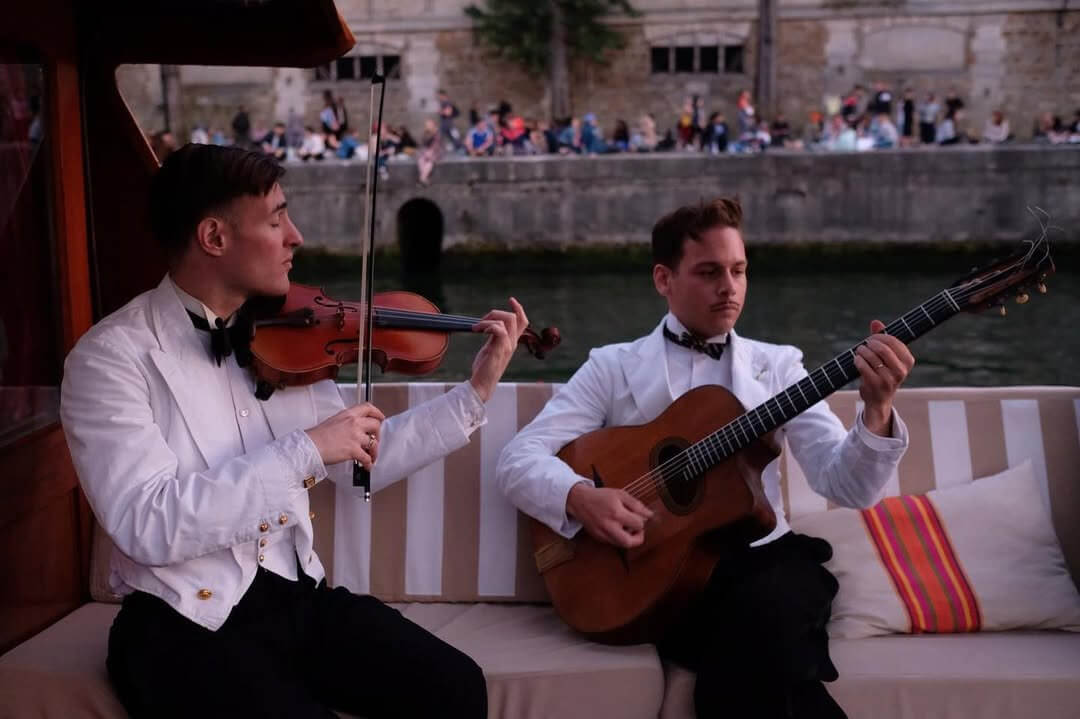
A live musician turns a Paris proposal or elopement into something the couple remembers long after the ring is on. A solo violinist or guitarist starts from €375; a saxophonist from €500. The fee covers learning the couple’s chosen song plus 30 minutes of on-site performance. Violin is the most popular choice, but guitarists, harpists, cellists, and saxophonists all perform regularly at rooftops, boats, and landmarks across Paris. Harp and cello raise the production value and pair well with violin in duos for larger setups. The same musicians also perform at elopements and intimate ceremonies.
Paris musicians for proposals and elopements at a glance
This table covers the musicians we can recommend for proposals, elopements, and weddings based on direct experience or verified public evidence. It is not exhaustive — Paris has more working event musicians than any single list can cover.
| Musician | Instrument | Sings? | Starting from |
|---|---|---|---|
| Adrian Delmer | Violin | No | From €375 |
| Arnald / SAXONARA | Saxophone | No | From €850 |
| Tatevik Baghmanian (Euterpe Paris) | Violin, ensembles | No | From €375 |
| Margot Fauquereau | Singer (vocals) | Yes | From €375 |
| Marjolaine Vauchelle | Harp | No | From €500 |
| Peter Deaves | Guitar + vocals | Yes | From €375 |
| Rafael Carmo | Violin | No | From €375 |
| Santiago Falcón | Violin | No | From €375 |
Best Paris musicians by instrument
Listed alphabetically within instrument categories. Evidence basis noted for all entries.
Violinists
Adrian Delmer — California-born and Paris-based, Adrian is one of the longest-serving proposal violinists in the city. He has worked with our team from the very beginning. His jazz and swing background gives him a warmer, less formal feel than a straight classical violinist, and he adapts well when a client wants to scale into a duo or small ensemble. Reliable across rooftops, landmarks, boats, and private venues. Evidence: planner network recommendations, Instagram portfolio (@adriandelmer_violin).
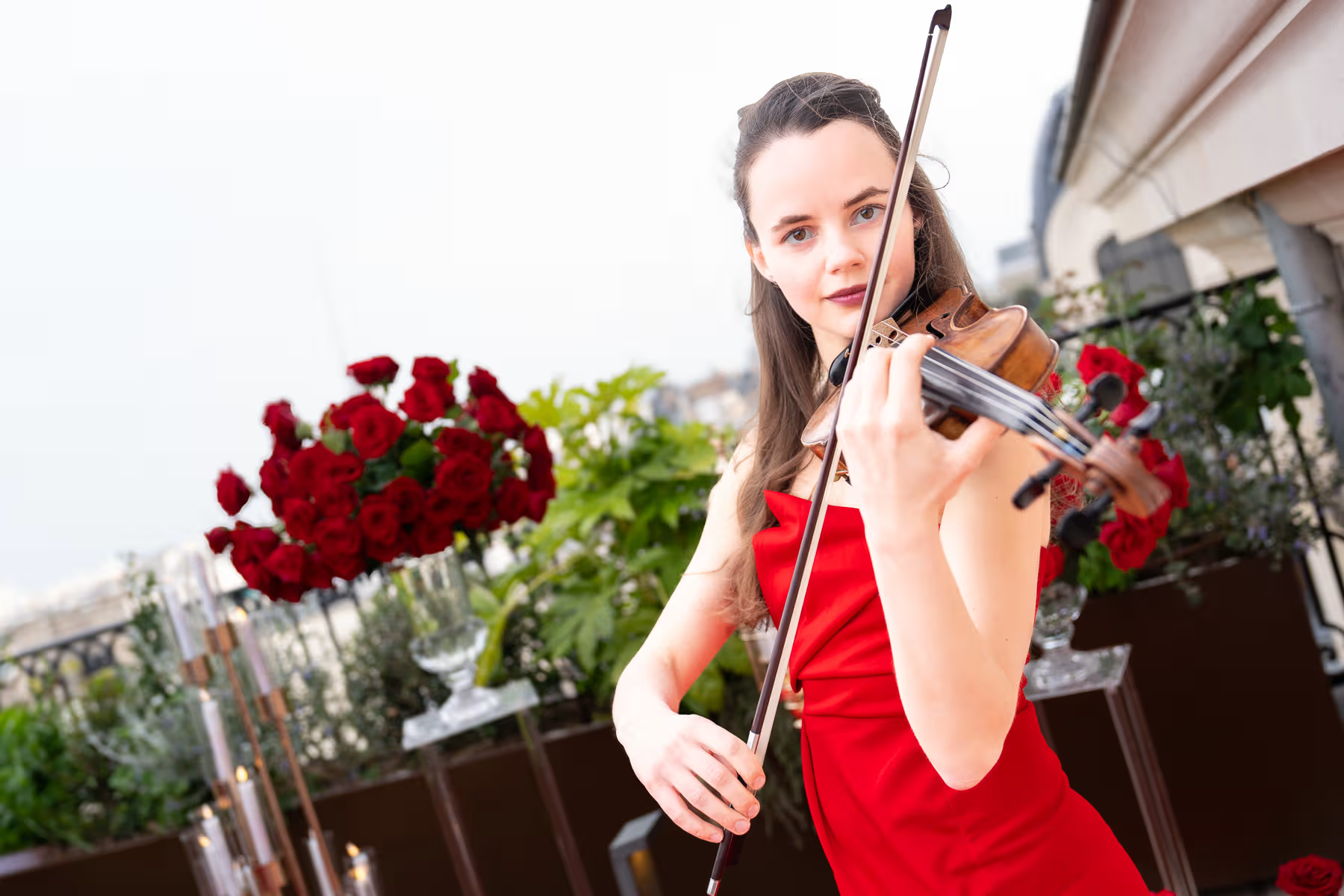
Euterpe Paris (Tatevik Baghmanian) — Among the most talented violinists working in the Paris proposal and elopement market — and also a musician-producer. Conservatoire-trained, often seen performing in period gowns, and runs the Euterpe Paris event music agency through which she offers a more fully art-directed experience. Offers solo violin, electric violin with backing tracks, and ensembles up to full quartet. Plays on a 19th-century Italian violin (R. Panizzutti) and a Yamaha SV140 electric. Also performs with Paris opera orchestras. During peak season, Tatevik performs at palace hotels like the Peninsula and Shangri-La almost daily. Evidence: WeddingWire 5/5, performances at Ritz Paris, Shangri-La, Maison Guerlain, Scarlett Entertainment listing, YouTube and streaming catalogue. Website: euterpeparis.com.
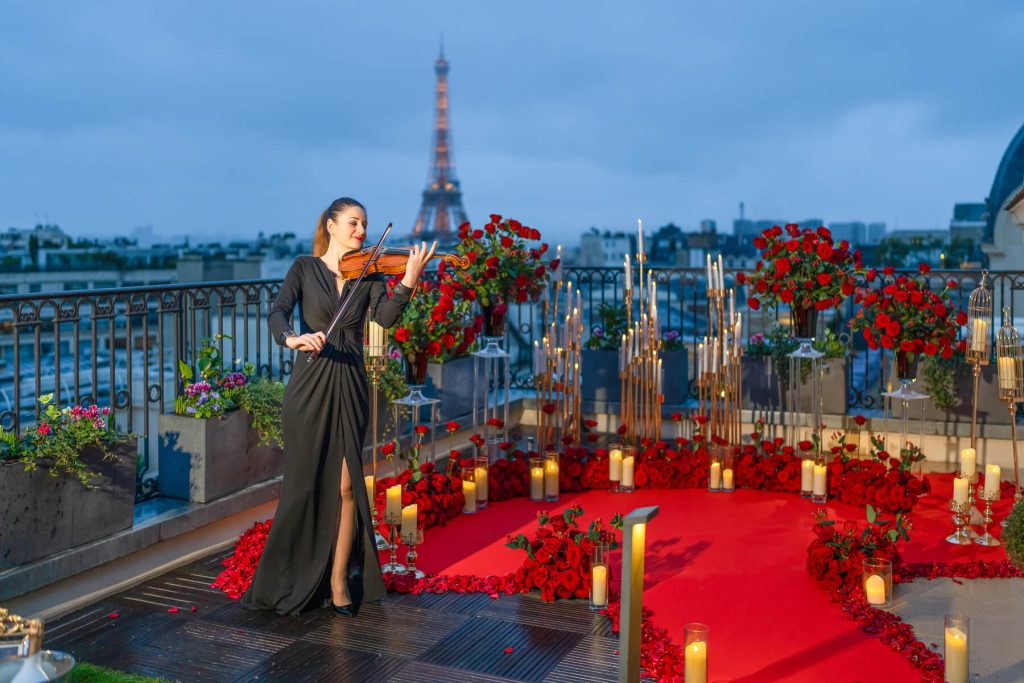
Rafael Carmo (The Paris Violinist) — Rafael has visible proposal footage from live Paris settings — not just polished reel content — which makes it straightforward to judge how he performs outdoors and around planning teams. We do not work with Rafael regularly, but his reputation in the Paris event community is well-established and this guide is about the best options for the client. Evidence: social media portfolio, planner recommendations. Instagram: @theparisviolinist.
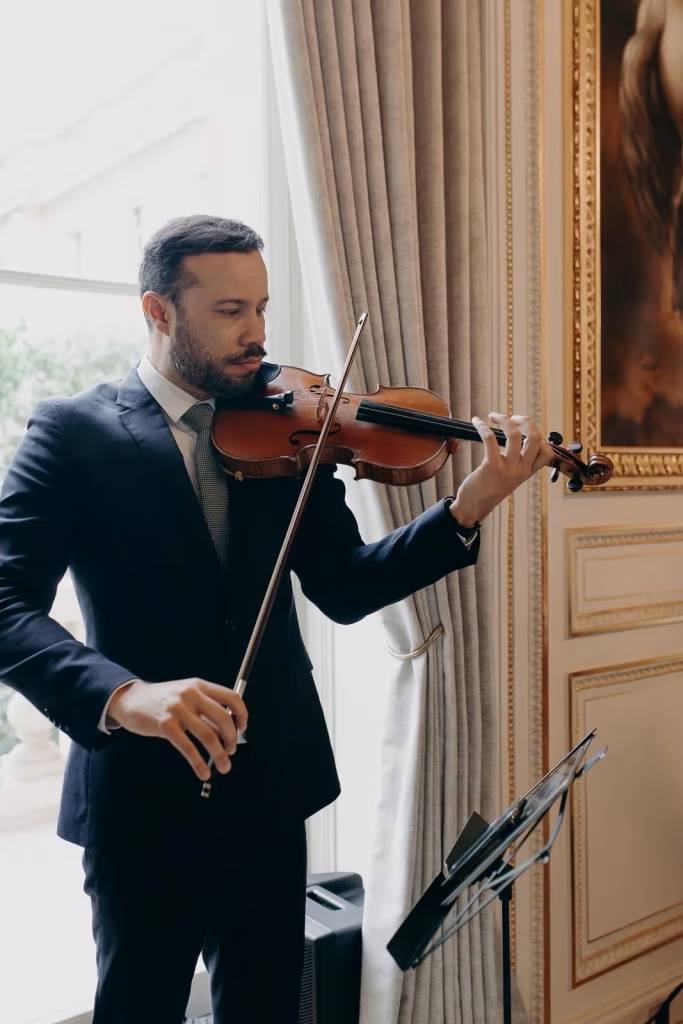
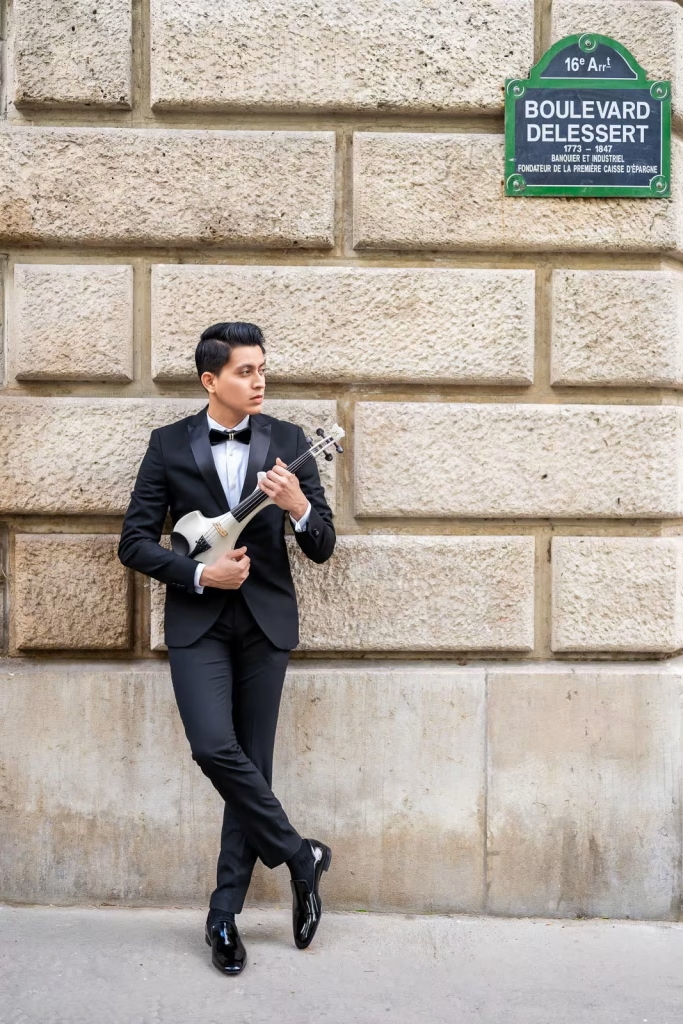
Santiago Falcón — Ultra-stylish and elegant — Santiago is a musical and visual presence in the frame. He looks sharp from top to bottom, which matters because the musician appears in the photo set and video. Featured in Vogue and People. Regular at palace hotels including the Peninsula and Shangri-La, and experienced with high-production destination weddings. Multilingual, comfortable with international clients. Also offers electric violin for couples who want a more contemporary sound. Evidence: press features, violinist-paris.com, multilingual correspondence, planner network. Website: violinist-paris.com.
Guitar and vocals
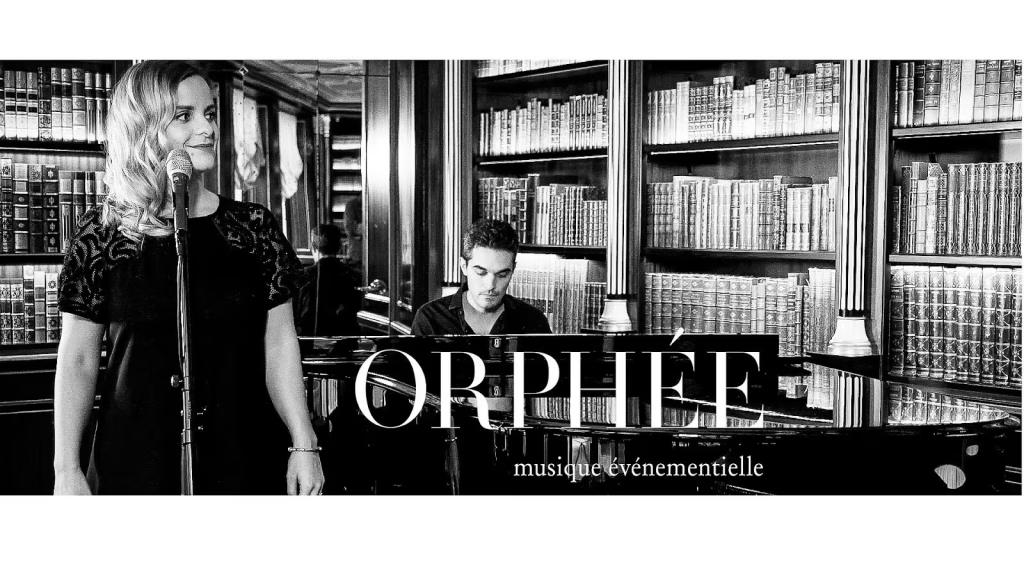
Margot Fauquereau (Proposal & Elopement in Paris) — A proposal-first singer rather than a general wedding vocalist, which matters. Her positioning is built specifically around intimate performances for proposals, elopements, and vow renewals in Paris. Reviews highlight coordination, punctuality, and ability to handle custom song requests for intimate ceremonies. Evidence: WeddingWire reviews and profile.
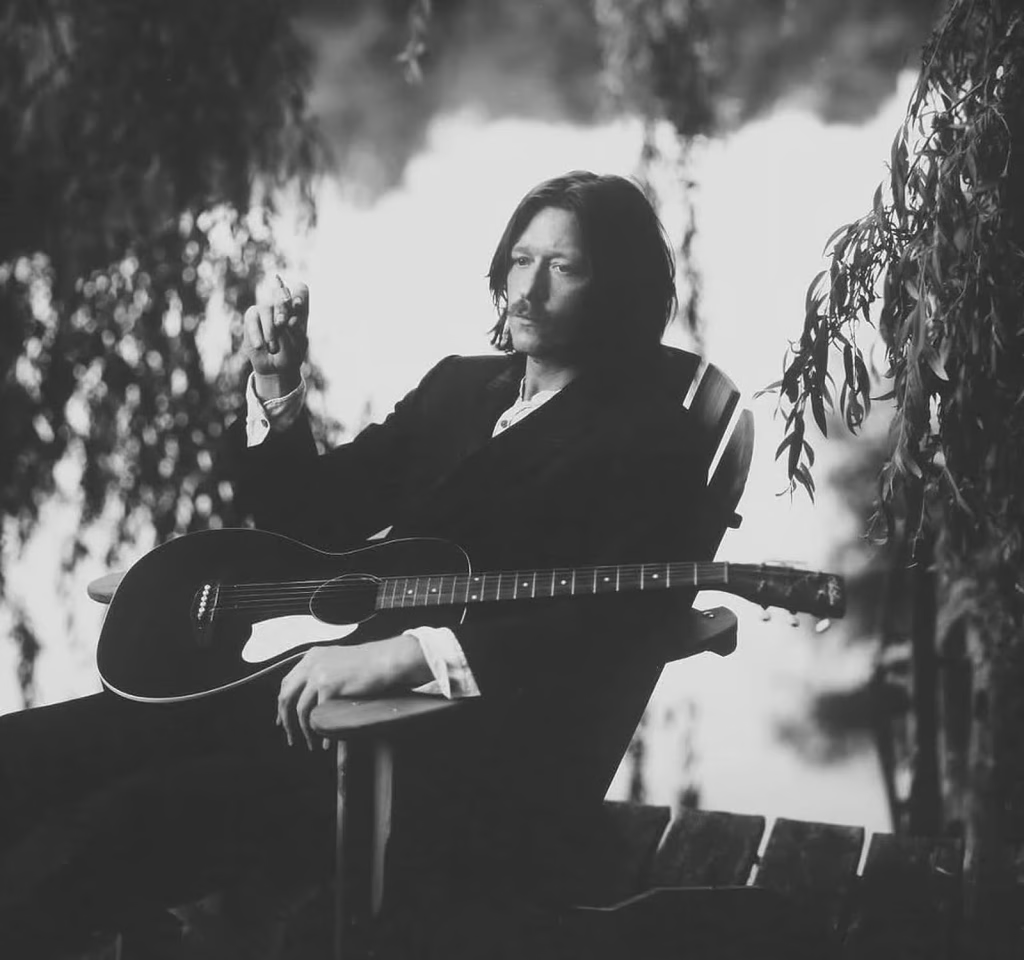
Peter Deaves — Liverpool-born and Paris-based, Peter brings a singer-songwriter voice with folk, Irish, and Americana roots — not a standard events-vocalist sound. Nobody in town combines guitar and vocals quite like him, and that lived-in warmth suits clients who want the music to feel personal rather than performed. Has performed at Shangri-La and other palace hotel proposals alongside EIP production teams. Evidence: direct EIP operational experience. Contact through EIP.
Saxophonist
Arnald / SAXONARA — Arnald positions himself as an event saxophonist for proposals and private events, not a jazz-club player — and that distinction matters for coordination and timing. Jazz, house, and pop styles. Reviews from Paris events describe him as highly professional, adaptable to the brief, and experienced with boats and rooftop settings. He is based in Spain and travels to Paris regularly for events — confirm availability and travel logistics directly when booking. This is the strongest verified option we have found for saxophone in the Paris proposal market. Evidence: saxonara.com, Instagram @saxonara_, verified client reviews.

Harpists
Marjolaine Vauchelle — Marjolaine Vauchelle — stylish, composed, and talented. She knows how to perform and — importantly — knows to look toward the couple while he is on his knee. That might sound like a detail, but it makes a visible difference in the photos and video. She also sings, which adds a dimension most harpists cannot offer. Paris-based, she performs regularly at palace hotel proposals including the Peninsula and Shangri-La. She and Santiago Falcón work particularly well as a violin-and-harp duo — musically and visually, the pairing raises the production value of any rooftop or terrace setup. Evidence: tagged on proposals at Peninsula Paris with EIP décor; @marjolaine.harpiste.
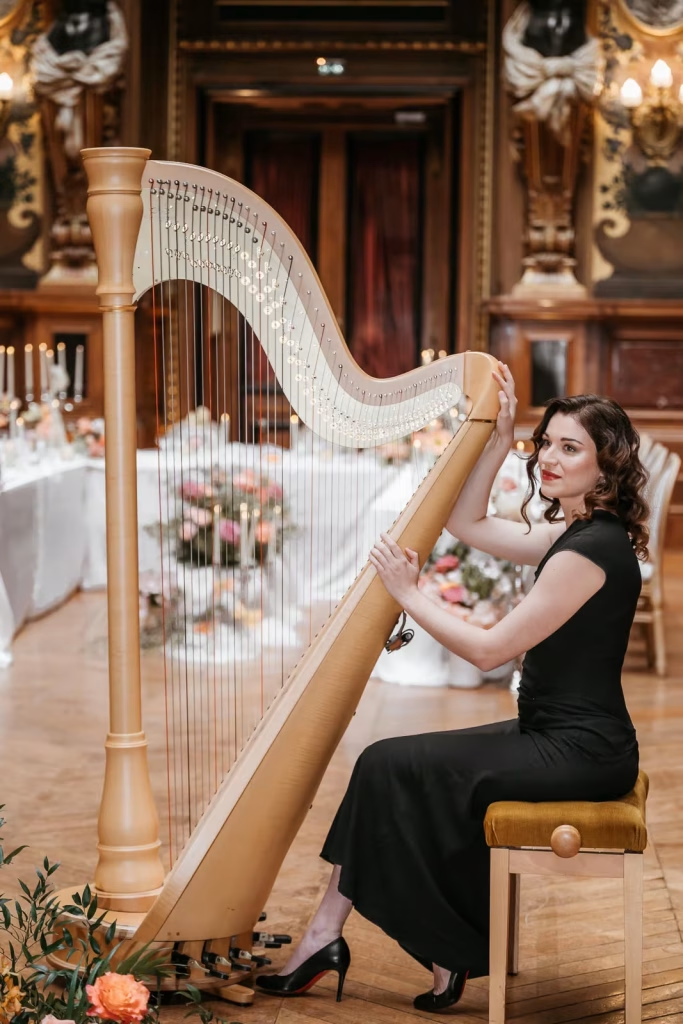
Myriam Serfass (A Harpist in Paris) — One of the most established harp specialists working in Paris. Myriam combines deep experience (over 25 years, including performances for Queen Elizabeth II and King Charles III’s coronation dinner in Paris), strong references, and a practical event-booking mindset. She offers solo concert harp or Celtic harp, larger ensembles on request, and coordinates directly with hotel concierges. Known for accepting last-minute bookings (48–72 hours). Wrote for Harp Column magazine and served on the World Harp Congress board. Evidence: WeddingWire reviews (including a proposal review praising 3-day turnaround), GigHeaven 10/10 from 17 reviews (from €450), aharpistinparis.com, @harpist.france.
Which instrument is best for a Paris proposal or elopement?
The instrument you choose affects the sound, the photos, the logistics, and the budget. Violin is the most popular.
Guitar with vocals works well when the couple wants lyrics alongside the melody. Saxophone suits dusk and waterside settings. Harp and cello raise the production value and pair well with violin in duos for larger setups. Here is what the main options involve.
Violin
The most popular choice for Paris proposals. A solo violin is portable, works in almost any space — rooftops, bridges, boats, gardens — and covers a wide repertoire from classical to pop and film scores. The violinist stands, needs no chair or floor mat, and can be repositioned mid-event if the photographer needs a different angle. If you are unsure which instrument to choose, violin is the safest and most versatile option.
Acoustic guitar (with or without vocals)
Warmer, more relaxed, and more modern than violin. Guitar and singing go naturally together, which is why a guitarist with vocals works well when the couple wants lyrics alongside the melody. The guitarist may stand or sit depending on style. Fully portable, no special access or transport needed. Pairs well with garden, picnic, and intimate rooftop settings.
Saxophone
Deeper, richer, and more cinematic than violin. Works especially well at dusk, near water, and on boats. A saxophone carries more volume than a violin, which is an advantage outdoors near the Seine but can be overpowering in a small hotel suite or tight rooftop. The saxophonist stands and is fully portable. Repertoire leans toward jazz, R&B, and pop ballads.
Harp
Harp raises the production value, makes a setup more distinctive than the more common violin, and pairs well with violin or other strings in a duo. But a harp is large, heavy, and delicate. The harpist always sits and needs a flat chair without armrests. The instrument requires vehicle transport to the venue — it cannot travel by Métro or in a standard taxi. A harp needs roughly 1.5 m × 1 m of level floor space, and the harpist may bring a small mat or carpet under the instrument for protection. If your setup has a specific colour scheme, coordinate the mat in advance — an arrival with a patterned rug under a red-carpet and floral setup creates a visual clash that shows in the photos. A harp will not fit on any boat. Sonically, the sound is soft and shimmering — it works best on hotel terraces and private rooftops where the visual presence matches the production value.
Cello
Cello raises the production value and adds volume and depth that a solo violin cannot match alone. The cello is most often used as a duo partner alongside a violin — the combination produces a rich, cinematic sound that fills a space without needing amplification. Like a harp, the cellist always sits and the instrument requires vehicle transport. The same floor-mat and access considerations apply. A cello will not fit on the small boat and is a tight fit on the large boat.
Electric instruments
Some violinists offer electric options — Santiago Falcón, for example, performs on electric violin for couples who want a more contemporary sound. An electric violin or guitar requires amplification (speaker, battery pack) and produces a more contemporary, louder sound. It solves projection problems at windy outdoor locations but adds gear to the setup and changes the acoustic character. If the couple wants a modern, high-energy feel, electric is worth discussing. It does not replace the acoustic option — it is a different sound entirely. For amplification, the musician usually provides a battery-powered portable speaker. Confirm who supplies the PA before booking.
How does a Paris proposal musician booking work?
A proposal musician charges a flat production fee, not an hourly rate. The fee covers work that happens before, during, and around the performance.
Before the day. The musician learns the couple’s chosen song from scratch — included in the fee, not billed separately. They also prepare a repertoire of additional songs for the portrait session that follows. This preparation takes real time and is the part of the work most clients never see.
On the day. The musician arrives well before the couple. They cannot show up at the same time — the music should already be playing or begin on a coordinated cue when the couple arrives. The musician warms up, finds the position agreed with the photographer and setup team, and waits for the go signal. After the proposal, they continue playing during couple portraits — typically 20–30 minutes after the kneel. Total performance time is 30–45 minutes. The musician arrives early to position within the setup and warm up, but the couple sees 30–45 minutes of live music.
Why this matters for pricing. A musician charging €375–€500 for a proposal is not charging for “30 minutes of music.” They are charging for song preparation, early arrival, positioning, coordination with the production team, the performance itself, and the understanding that they may wait in the cold for 45 minutes if the couple runs late. When you see the fee, understand what it covers. The flat fee includes one custom song learned from scratch, a prepared repertoire for the portrait session, early arrival, positioning, and 30–45 minutes of performance. If the couple wants additional custom songs learned, there may be a small surcharge — confirm at booking. If the production runs late and the musician needs to stay longer, overtime may apply. Most musicians maintain a broad repertoire of proposal and ceremony classics that the couple can choose from at no extra charge; the one custom song — the couple’s personal favourite — is part of the base fee.
What separates an event musician from a concert musician
A violinist who plays at the Opéra Garnier may be technically excellent and still be wrong for a 30-minute rooftop proposal. The skill sets are different.
An event musician needs to do all of the following: learn a pop song from a phone recording, not just from sheet music. Take timing cues from a planner or photographer in real time. Extend a song by looping a section if the couple is late. Cut a song short if the moment happens faster than planned. Play outdoors in variable light and temperature. Stand in a specific position relative to the camera and the setup. Look toward the couple during the kneel, not down at a music stand. Dress to match the production value of the event. Communicate clearly in English before and during the event. Show up early, warm up quietly, and stay invisible until the cue.
A concert musician is trained to play from a score, in a controlled acoustic space, with a conductor setting the tempo. That is a different discipline. Some musicians do both well. Many do not. When you are hiring for a proposal, ask specifically: how many proposals have you played? Do you work with planning or coordination teams? Can you take a hand signal to start, hold, or finish?
Practical constraints: where instruments do and do not work
A musician can perform at any Paris venue where the weather is fair, they have physical access, and there is enough space.
Rain, snow, or high wind: No acoustic instrument works outdoors. The instruments are built by master luthiers from aged tonewoods. Rain risks an instrument the musician depends on for their career. Weather backup is a hard rule, not a preference.
Boats: The small boat does not fit any musician. The large boat accommodates violin, guitar, and saxophone but not harp or cello.
Harp and cello access: Both require vehicle transport, a service lift or ground-floor entry, wide doorways, and flat floor space. Give the musician the exact access conditions before confirming the booking.
Everywhere else: All five instruments work at rooftops, landmarks, gardens, indoor venues, and château grounds in fair weather.
Dressing
All musicians we recommend dress for the occasion: gowns, tuxedos, or sharp dark concert attire. A poorly dressed musician can diminish the entire production value — and it shows in the photos and video afterwards. The musician is in the frame throughout the shoot. Concert-level presentation is a hiring criterion, not a preference. Some of the larger château proposals and elopements have the planners coordinate period gowns or specific attire with the musicians to match the setting. If the visual standard matters to you — and it should — discuss wardrobe before confirming the booking.
Duos, trios, and quartets
A solo musician is the standard for proposals. For couples who want a fuller sound, a duo is the most practical upgrade. Trios and quartets are wedding territory.
| Combination | Sound | Best for |
|---|---|---|
| Violin + guitar | Warm, modern, pop-friendly. Guitar provides rhythm and harmony; violin carries melody. | Proposals, elopement ceremonies, cocktail hours |
| Violin + cello | Rich, cinematic. The classic pairing with melody and bass depth. | Elopement ceremonies, indoor settings, formal dinners |
| Violin + harp | Ethereal, elegant. The most visually and sonically striking duo for intimate settings. | Private rooftops, hotel terraces, garden ceremonies |
| Guitar + vocals | Modern, personal, relaxed. The strongest option when the couple wants recognisable songs sung live. | Proposals, casual elopements, cocktail hours |
| String trio (violin, viola, cello) | Full, balanced string sound. Nearly as rich as a quartet at lower cost. | Wedding ceremonies, large elopements |
| String quartet (2 violins, viola, cello) | The standard. Full orchestral richness. Carries for 100–200+ guests. | Wedding ceremonies, large receptions, château events |
For proposals: solo violin, solo guitar, or solo saxophone. For elopements where the couple wants something richer: violin + guitar or violin + cello. For weddings and celebrations with 20+ guests: trio or quartet. Larger ensembles suit château grounds and large indoor venues where a single instrument may not carry the space. For a château proposal or a larger elopement, having the musicians stay on to play discreetly through dinner raises the production value significantly — discuss multi-hour pricing at booking.
What to check before you book a musician
These are the details that separate a strong booking from a regrettable one. Most come from situations we have seen directly on EIP productions or that couples report after the fact.
Ask how many proposals they have done, not just how well they play. We have seen conservatoire-trained musicians freeze when the couple arrived 20 minutes late and the song needed to be looped on the fly. Event work requires different instincts from stage work — a hand signal from a planner, a song cut short mid-bar, a sudden repositioning because the light changed. If they have not done it before, the first time should not be your event.
Hear them play in a real setting, not just a studio recording. Some musicians post polished, post-produced video showcases that do not reflect their live sound outdoors. Ask for raw footage from a past proposal or outdoor event. Shaky phone video from a client is more useful than a produced reel.
Read the weather clause before you sign. Professional instruments are vulnerable to rain, humidity, wind, and temperature swings. A weather clause is not fine print — it protects an instrument the musician depends on for their livelihood. Confirm what triggers a cancellation versus a reschedule, and plan a covered backup for any outdoor event between October and April.
Confirm the instrument fits the venue. We have coordinated a harp delivery up a spiral staircase in a Haussmann apartment — it required two people and advance measurement of the door width. A narrow dock gate onto a boat can be worse. Give the musician the exact access conditions: door widths, stairs, distance from parking to the setup point. Do this before confirming the booking.
Agree on a cue system in writing. The musician needs to know when to start, when to hold, and when the proposal is happening. A written cue sheet with at least three signals — couple approaching, couple in position, he is going down — prevents the most common coordination failures. The photographer or planner holds the cue, not the person proposing.
Brief them on gaze and positioning. This is the most proposal-specific detail and the least discussed. When the gentleman drops to his knee, the musician is in the frame. We have received photos back where the musician was looking at their phone, at their sheet music, or away from the couple — the visual reads as disinterest. Brief the musician explicitly: where to stand relative to the couple and camera, where to look during the kneel, and that sheet music should be memorised or placed out of the sightline for the core two minutes. The strongest musicians understand this instinctively. The rest need to be told.
Send your song requests in writing at the booking stage. Not a week before. Not the morning of. If the musician has never played the requested song, they need preparation time — the earlier the better, but these are working professionals who learn new material regularly. Most can prepare a standard arrangement within a few days; peak season or unusual repertoire may need more lead time. Confirm the song, confirm they have performed it before or will prepare it, and ask for a short demo if it is not on their listed repertoire.
Verify the contract covers the basics. Performance duration, setup arrival time, specific songs agreed, weather and cancellation terms, payment schedule, and equipment responsibility. A handshake booking with no written terms leaves all the risk with the couple. Standard in Paris is a 50% deposit at booking via wire transfer or PayPal, with the balance due before the event. Non-refundable deposits are normal. Cancellations within 60 days of the event typically require 75–100% of the remaining balance.
Coordinate the floor mat. A harpist or cellist may bring a mat or small carpet under their instrument for protection. If your event has a styled setup with a specific colour palette, and the artist arrives with a patterned oriental rug that clashes with the florals and carpet, it shows in the photos. Ask in advance what they bring and whether it matches the setup aesthetic. This is a production detail, not a nitpick.
How we chose these musicians
All musicians on this page have worked with a Paris proposal or elopement planning team, performed at outdoor and private venue events, and demonstrated the coordination skills that short-format, surprise-timed events require. We selected based on repertoire flexibility, punctuality record, communication in English, visual presentation, and willingness to take direction from an on-ground production team.
No musician paid to appear on this list. Vendors are listed alphabetically within instrument categories. Ordering is not a ranking. Where we have direct operational experience with a musician, we say so. Where our evidence is based on public reviews, portfolio, or industry reputation, we say that instead.
Prices last checked: March 2026.
Book standalone, through EIP, or bring your own
Three ways to add a musician to your Paris proposal or elopement:
| Option | How it works | Best when |
|---|---|---|
| Book standalone | Contact the musician directly using the links above. You handle coordination, timing, and cues yourself. | You have your own planner or photographer coordinating the day, or you are confident managing the logistics yourself. |
| Book through EIP | Add a musician to any EIP proposal or elopement package. We handle song coordination, arrival timing, positioning, and cues on the day. | You want one team managing the entire production. The musician is briefed, positioned, and cued by our on-ground coordinator. |
| Book EIP + bring your own musician | You book an EIP package and bring a musician we did not source. We coordinate with them on timing and positioning as long as they confirm in advance. | You already have a musician you trust or a specific artist you want, and you want EIP handling everything else. |
FAQ
How much does a live musician cost for a Paris proposal?
A proposal musician in Paris charges a flat production fee starting from €375 for violin or guitar and from €500 for saxophone. This covers song preparation, early arrival, positioning with the setup team, and 30–45 minutes of performance. Harp pricing is on request due to transport logistics. Wedding bookings are priced differently — typically by the hour or in multi-hour blocks. See the full pricing table above.
Can a musician play at the Eiffel Tower?
Not on the tower itself. Eiffel Tower-view locations like Bir-Hakeim, Trocadéro, the Seine riverside, Pont Alexandre III, and Champs de Mars are where proposal musicians perform. These are public locations and all five instrument types work in fair weather. Permit rules for public performance in Paris can change — your planning team should confirm current requirements before the event.
What happens if it rains on the day?
The musician will not play an acoustic instrument in rain or heavy wind. This is a hard rule, not a preference — the instruments are professional instruments that can be damaged by moisture. Our team monitors forecasts and adjusts timing where possible. When outdoor performance is not safe, the event moves to a covered backup location or the musician is rescheduled. Weather clauses are standard in musician contracts in Paris.
How far in advance should I book a musician for a Paris proposal?
Two to four weeks is a comfortable window. Most proposal-specialist musicians in Paris can confirm within 48 hours for last-minute requests if they are available. Wedding bookings need longer lead times — three to six months for peak season weekends. If you want a specific song learned from scratch, send it as early as possible — most musicians can prepare within a few days, but peak season and unusual repertoire may need more lead time.
Is violin or saxophone better for a proposal?
Violin is the most versatile choice and works in almost any space — rooftops, bridges, boats, gardens, and indoor venues. Saxophone is deeper and more cinematic, and works especially well at dusk, near water, and on boats, but can be overpowering in a small hotel suite or tight rooftop. If you are unsure, violin is the safer default. If the couple prefers jazz, R&B, or a more contemporary feel, saxophone is worth discussing.
Can I add a musician to my EIP proposal package?
Yes. A musician is an add-on to any EIP proposal or elopement package. When you book through EIP, we handle song coordination, arrival timing, positioning, and cues on the day. You can also bring a musician we did not source — we coordinate with them as long as they confirm in advance.
Is there a minimum booking time?
Usually yes. The standard proposal booking covers 30–45 minutes of performance. The musician arrives early to position and warm up, but the couple sees 30–45 minutes of live music. Much of the real work — learning the song, rehearsing the arrangement — happens before the event day. For weddings and receptions, multi-hour blocks are standard. Harpists and cellists need a chair and flat floor space — coordinate this with your planning team in advance.
Can I hear the musician before booking?
Yes. Ask for raw outdoor performance footage, not just a studio recording. Most musicians in our recommendations have YouTube channels, Instagram performance videos, or streaming profiles. Shaky phone video from a real proposal is more useful than a produced reel.
Do musicians coordinate with the photographer and setup team?
Yes. A proposal musician should be comfortable taking timing cues from the planner or photographer — not the person proposing — and this is a key hiring criterion. When you book through EIP, our on-ground coordinator handles all cues and positioning. When you book independently, confirm with the musician that they are comfortable working with a team and following a cue sheet.
What should I ask a musician before booking?
Ask about proposal experience, cue handling, custom-song lead time, and weather terms. Specifically: how many proposals or elopements have you played? Do you work with planning or coordination teams? Can you take a hand signal to start, hold, or finish? Can you learn a custom song within 14 days? Do you have a weather clause and cancellation policy in your contract? See our full pre-booking checklist above.
Planning a proposal or elopement in Paris?
WhatsApp us your date, preferred instrument, and setup type. We reply with the full pricing PDF and musician availability, usually within the hour.